
In this month’s writing advice I am going to break down how I approach creating the characters for my books- not just the individuals, but the dynamics of how they work together as a cast as well! Let’s dive in!
Usually when I have the idea for a book, that starts with a few or more characters. Maybe I picture a scenario they get themselves into, or I “overheard” a conversation between them- and that is the seed for the novel or series. I start with those few or that handful of characters that first come to mind and I just hang out with them for a while. I daydream about them, and they sort of flesh themselves out in those daydreams as I am getting to know them.
In those daydreams I ask myself why they think or feel the way they do, or what they’ve been through to give them their current motivations or desires. The more I daydream about them and what they are like, the more they fill out into defined people. It’s usually around this point that I start to realise what their Enneagram composition might look like based on their core misbelief or fear. That’s right, I use the Enneagram to make my characters deep, complex, and to also add dimension without them acting “out of character” throughout the story.
Why the Enneagram?
I believe the Enneagram is the most useful tool for this purpose because it doesn’t fit people into a box. It allows for ebb and flow based on stressors in situations, and what different outside forces might bring out in us. See I’m an INTJ- but I don’t always act like one depending what I have to do. And when I’m not acting like an INTJ, that doesn’t mean that I am acting out of character or pretending to be someone I’m not. I means, I can’t be put in a box. And neither can our characters. If we put our characters into tight little boxes, then they run the risk of falling flat, being unbelievable or even worse, unrelatable. We NEED our characters to be resonant and deeply relatable because that is what gets readers invested in our stories.
The Enneagram can help you assess a baseline for your character’s personality, as well as how they act when feeling safe and happy (like around their closest friends), or when stressed or under pressure (when pushed to the limit how do they deviate from that baseline). It can also add depth and complexity to your characters because they will have a unique tri-type, not pigeonholed to one number, and expected to be just like everyone else who is that number… So you see how this helps develop more detailed and unique personalities!
Implementing the Enneagram as a Tool for Character Creation
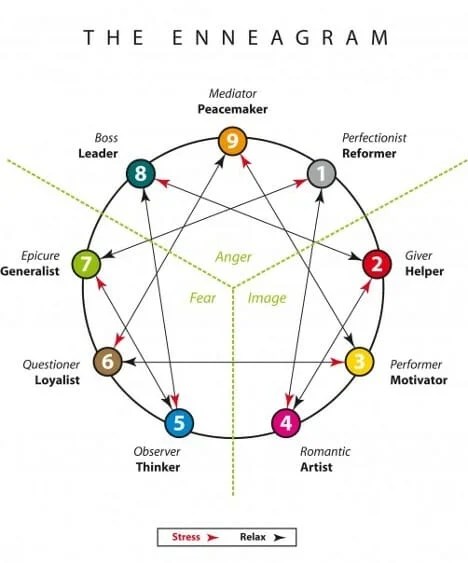
The Enneagram is a chart of numbers 1-9
(For more information on how the Enneagram works visit the Enneagram Institute.)
Your character will have a “core” number that acts as the foundation of their personality. Each number (based on the chart) has specific numbers they move to in stress (taking on that other number’s negative characteristics- the red arrow) and in growth (taking on that other number’s positive characteristics- the black arrow). Your character’s tri-type is composed of one number from each triad (the green pie slices) that resonates most with their personality.
As an Example I am an Enneagram 3 (core number) – 5 – 1 (the numbers from the other two triads that compose my tri-type). As a 3, I move to 9 in stress, and 6 in growth (as all 3s do). I also have a strong wing 4 and a weak/broken/gimpy wing 2 (the numbers on either side of my core number). Certain people make it easier to move into my 2 wing based on their personality/circumstances. Certain people or situations stress me out more than others, or make me feel safer than others- which will affect what my personality manifests as in any situation. So I am not being fake, if I appear to be a different person around one person than another- because they bring out different aspects of my personality. It’s the same with our characters.
If you’ve ever gotten feedback from beta readers, or God-forbid in reviews about characters acting “out of character”- and if that is an area of struggle for you- then this tool will be of huge use. Using myself as an example again; if I was your character, then you would know that I would have a really strong personality, but would also be afraid to rock the boat too much less it lower my standing in the group (survival instincts of a number from the “image” triad)- or when pushed beyond my limits of stress, I would move to 9 where I’d become completely passive, and “check out” for the sake of maintaining some personal peace. So though as a character I am super confident, and outspoken and maybe even a leader in the group- it actually wouldn’t be out of character for me to shut down and refuse to make a decision, under the right circumstances.
See knowing our characters, and where their lines are, and what it takes for them to be pushed over the edge, dictates how we can break them at pivotal moments in books, without it feeling disingenuous to our readers. If you have an unhealthy 3 character pushed over the edge and start acting like an 8- this is going to inherently feel “off” to readers because 3s don’t move to 8. And if they have 3s in their lives, who they subconsciously relate with your character, then they know that and are drawing those comparisons. In fact 8 and 7 are the only two numbers on the Enneagram that I personally never touch, but other 3s might if they have them in their tri-types. So there is a way to have a character act a certain way, but it has to be within their character to do so. See how this opens the box wide, but also helps give you insight and direction with what all you can pull with your characters! Isn’t it wonderful!
I know it can seem like a lot at first, if you aren’t familiar with the Enneagram yet. But trust me, once you read up on the numbers a bit, this tool is a total game changer, especially if you tend to write stories with ensemble casts!
Implementing the Enneagram as a Tool for Cast Complexity
I highly recommend you check out the link above and familiarise yourself with the chart and the different numbers. Using this tool- you can see how it can help to develop deeper more complex characters. But it is also supremely useful in creating a cast of characters with dimension, unique relationship dynamics within the cast, and with a complex diversity of personality types and how they bounce off of and react to one another.
You can have total diversity, where everyone has a different core number, but with similarities because they share a number in their movement, or in their tri-types. Or you could showcase how different similar-people can be by having characters with the same core number, but different tri-types. (See my example below in how I used this in The Kingdom Come Series Cast)
Using this as a tool really helps to bring diversity and realistic dynamics to your groups. For instance in my Kingdom Come Series I have an ensemble cast of 6 core characters who are all close friends and 3 of which are siblings. Now the siblings are going to be close in a different way than they are with their friends, and in some ways further apart with each other than they are with their friends. A great example to use is my character Olivier. He is an Enneagram 7w6. He is fun loving, and the life of the party and he avoids pain because he doesn’t know how to handle it well, or at all. He can come across as immature, but in reality is a well of emotion he doesn’t know how to handle. So let’s see how the different members of the group bring out different sides of our boy!
- He is desperate for approval from his role model Noland the 9, who really brings out Olivier’s wing 6 loyalty as Noland moves to 6 in stress (which is like always). Thus Olivier sees Noland in a sense as who he could maybe grow up to become. He admires in Noland the characteristics and qualities that he has a little of himself, and wants to develop.
- He feels like an outsider with his siblings Emile and Amelia who are twins and more introspective and reserved as a 5 and a 4 respectively.
- He can relax more and just let loose and have fun with this best friend Achaia who is a 1 and moves to 7 in health which makes them super similar though fundamentally different. She meets him in his absolute comfort zone in a healthy way, and the two can just escape together and be happy for a time.
- His partner Yellaina who is more of a 2, brings out the protective side of his loyal wing 6. Which makes him want to rise up to the challenge (and step into those qualities that he associates with being like Noland who incidentally is someone Yellaina loves and trusts more than anyone else).
All of those dynamics without even going so deep as to dive into his movements or his tri-type. That was all just with his core number and wing! (If you’re interested in going deeper, we will get into all of that when we get to him in our Character Study series!)
Hopefully that helped you to see how one character, staying totally within character can be different things to different people, and how those different numbers and personality types might affect them on a deeper level- maybe even helping you to flesh out their insecurities, their deepest fears or misbeliefs, and their driving motivation.
Dynamics with groups are so much fun to play with, and dynamics within individual characters can really make or break your story.
If you want to take your cast and characters to the next level- consider using the Enneagram to create deeper complexity and relatability.
For more detailed and unpacked examples of this- check out my Character Study Series that started with Shael.

 brandyange.me